
Spring 2026
In this challenge, students will design, build, and calibrate one or more simple weather instruments (e.g., air pressure, wind speed, rainfall, temperature, or humidity).
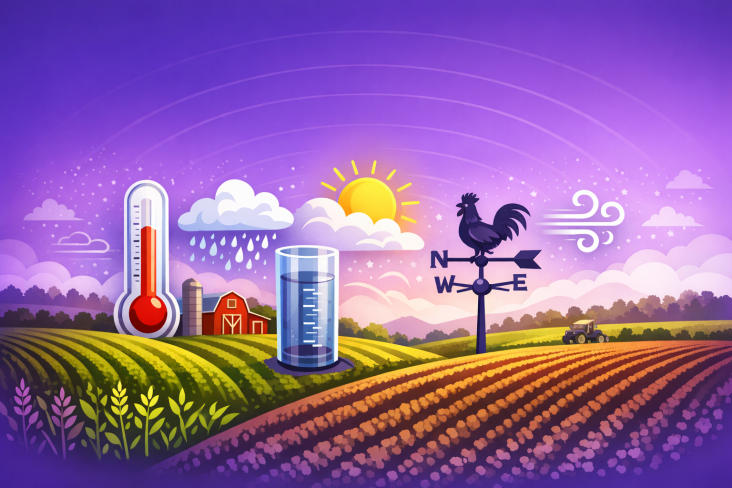

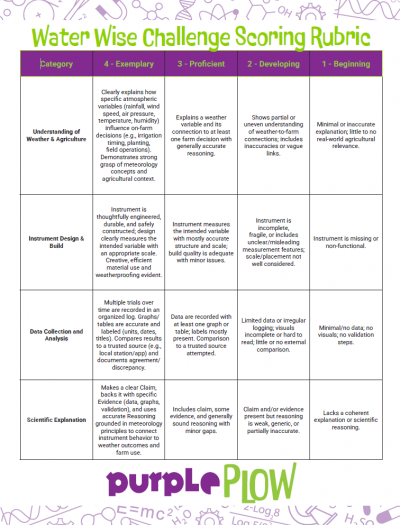
In this challenge, students will design, build, and calibrate one or more simple weather instruments (e.g., air pressure, wind speed, rainfall, temperature, or humidity). Over a set period, they will monitor and record local weather, analyze patterns, compare their measurements with trusted sources, and explain how farmers could use those data (e.g., timing field work, adjusting irrigation, protecting seedlings). The final product should demonstrate both the instrument's functionality and the value of weather monitoring for farming.
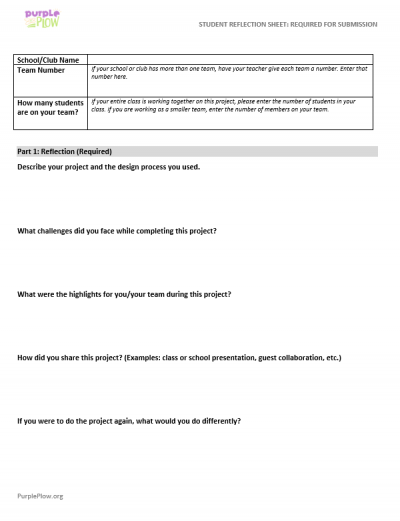
You can run a challenge with our week-long guide or our multi-week guide. Either one you select, you can enter to win a prize. Just remember to fill out the Student Reflection sheet when you submit! We also created this PowerPoint to help walk your class through the project.
Both challenge packets offer guiding questions, standards, a materials list, and suggested design process information. There is also a content packet that offers more background information on weather and how it affects farming to get students started.
Get creative with your prototype! In the past, students have used recycled materials and digital tools like Minecraft education.
We also suggested connecting with farmers, equipment managers, or engineers in your community to learn more! You can look up your local Farm Bureau or Ag in the Classroom to see if they can connect you.
All guides are at the bottom of the page.
Good luck, design teams!

Next Generation Science Standards
nextgenscience.org
• MS-ETS1-1 Define the criteria and constraints of a design problem with sufficient precision to ensure a successful solution, taking into account relevant scientific principles and potential impacts on people and the natural environment that may limit possible solutions.
• MS-ETS1-2 Evaluate competing design solutions using a systematic process to determine how well they meet the criteria and constraints of the problem.
• MS-ESS2-5 Collect data to provide evidence for how the motions and complex interactions of air masses result in changes in weather conditions.
COMMON CORE STANDARDS
corestandards.org/mathematics-standards
• CCSS.MATH.CONTENT.6.EE.B.6 Use variables to represent numbers and write expressions when solving a real-world or mathematical problem; understand that expressions in different forms can represent the same number.
• CCSS.MATH.CONTENT.6.RP.A.3 Use ratio and rate reasoning to solve real-world and mathematical problems, e.g., by reasoning about tables of equivalent ratios, tape diagrams, double number line diagrams, or equations.
• CCSS.MATH.CONTENT.6.SP.B.4 Display numerical data in plots on a number line, including dot plots, histograms, and box plots.
• CCSS.MATH.CONTENT.6.SP.C.5 Summarize numerical data sets in relation to their context, such as by:
a. Reporting the number of observations.
b. Describing the nature of the attribute under investigation, including how it was measured and its units of measurement.
c. Giving quantitative measures of center (median and/or mean) and variability (interquartile range and/or mean absolute deviation).
d. Describing any overall pattern and any striking deviations from the overall pattern with reference to the context.
e. Relating the choice of measures of center and variability to the shape of the data distribution and the context in which the data were gathered.
corestandards.org/english-language-arts-standards
• CCSS.ELA-LITERACY.RST.6-8.1 Cite specific textual evidence to support analysis of science and technical texts.
• CCSS.ELA-LITERACY.RST.6-8.3 Follow precisely a multistep procedure when carrying out experiments, taking measurements, or performing technical tasks.
• CCSS.ELA-LITERACY.RST.6-8.7 Integrate quantitative or technical information expressed in words in a text with a version of that information expressed visually (e.g., in a flowchart, diagram, model, graph, or table).
• CCSS.ELA-LITERACY.WHST.6-8.1 Write arguments focused on discipline-specific content.
a. Introduce claim(s) about a topic or issue, acknowledge and distinguish the claim(s) from alternate or opposing claims, and organize the reasons and evidence logically.
b. Support claim(s) with logical reasoning and relevant, accurate data and evidence that demonstrate an understanding of the topic or text, using credible sources.
c. Use words, phrases, and clauses to create cohesion and clarify the relationships among claim(s), counterclaims, reasons, and evidence.
d. Establish and maintain a formal style.
e. Provide a concluding statement or section that follows from and supports the argument presented.
• CCSS.ELA-LITERACY.WHST.6-8.2 Write informative/explanatory texts, including the narration of historical events, scientific procedures/experiments, or technical processes.
a. Introduce a topic clearly, previewing what is to follow; organize ideas, concepts, and information into broader categories.
b. Develop the topic with relevant, well-chosen facts, definitions, concrete details, quotations, or other information and examples.
c. Use appropriate transitions to clarify relationships among ideas and concepts.
d. Use precise language and domain-specific vocabulary to inform about or explain the topic.
e. Establish and maintain a formal style and objective tone.
f. Provide a concluding statement or section that follows from and supports the information or explanation presented.
• CCSS.ELA-LITERACY.SL.8.4 Present claims and findings, sequencing ideas logically and using pertinent descriptions, facts, and details to accentuate main ideas or themes; use appropriate eye contact, adequate volume, and clear pronunciation.